STEP / 01
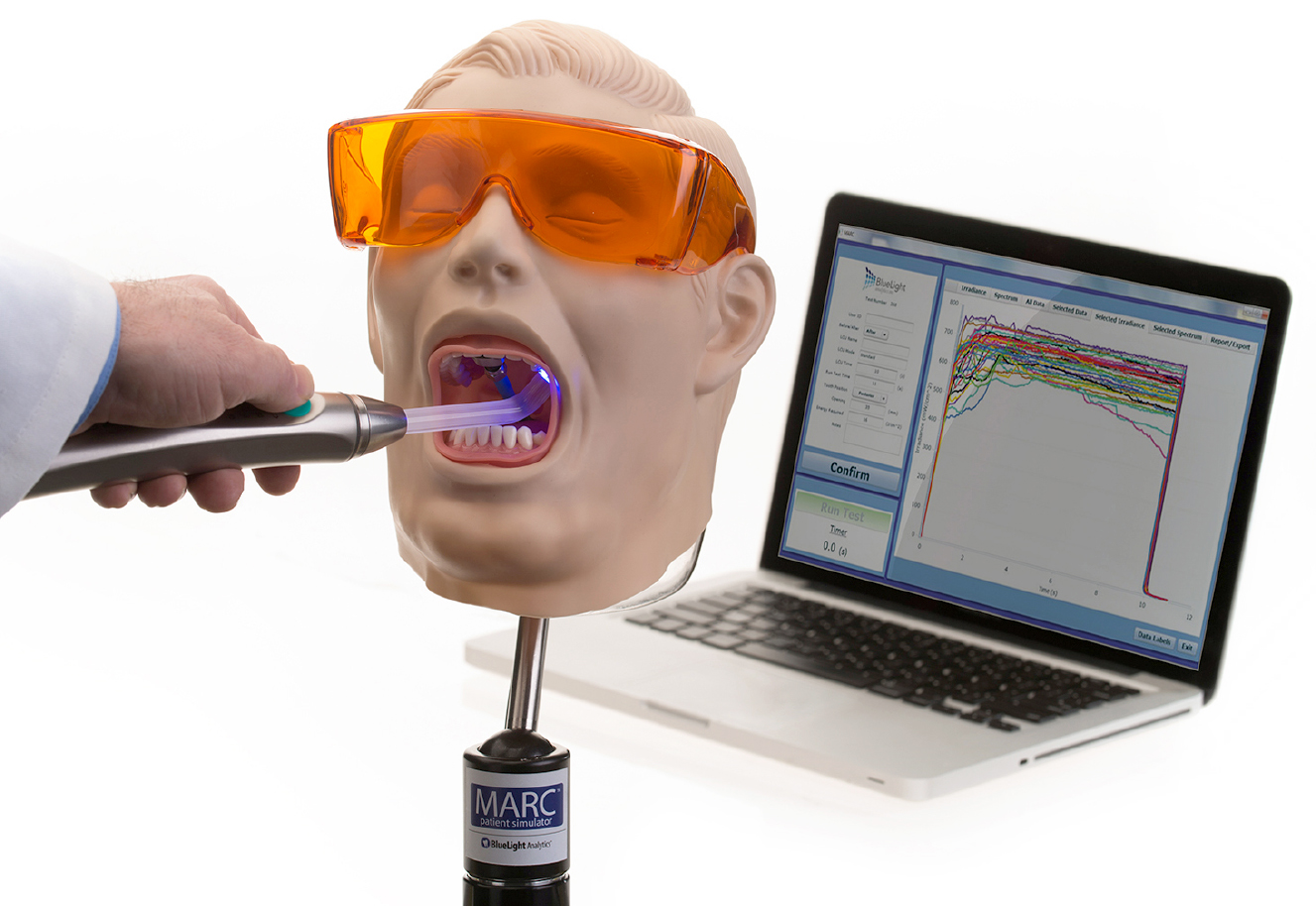
Students cure into a typodont head.
A laboratory-grade spectroradiometer with sensors embedded in the teeth, at real anterior and posterior positions, in the restorative posture students will use on patients.
Products / MARC Patient Simulator
Every dental school teaches light-cured composites, adhesives, sealants, and cements, yet very few can measure whether students deliver enough light in the mouth. The MARC Patient Simulator makes the invisible skill visible: real-time irradiance and radiant-exposure feedback on every cure, at real tooth positions, ready to grade.
The teaching gap MARC-PS closes
Students see blue light on for ten or twenty seconds and assume the filling is cured. But small errors in angulation, distance, tip contamination, or movement leave resins under-cured, and the published evidence is consistent that most students, and many practitioners, deliver inadequate energy without knowing it. 68% of dentists delivered less than 10 J/cm² to a Class I restoration in one study.
The most uncomfortable finding: students and their instructors believed the curing was adequate, until the simulator proved otherwise. Under-curing surfaces later as post-operative sensitivity, marginal staining, secondary caries, and premature failure, reflecting on the education your graduates received.
How it works
Managing Accurate Resin Curing: the MARC platform behind 200+ peer-reviewed publications, in a form your preclinical lab can teach with.
A laboratory-grade spectroradiometer with sensors embedded in the teeth, at real anterior and posterior positions, in the restorative posture students will use on patients.
Exactly what the light delivered, irradiance (mW/cm²) and radiant exposure (J/cm²), visible the moment the student lifts the light off the tooth.
Per-student, per-attempt, per-tooth data. Light curing becomes a documented, trackable competency instead of an unassessed manual skill.
The case for your program
Light curing is one of the most frequently performed clinical steps in restorative dentistry, and one of the only ones most programs can't yet measure.
Quantifiable irradiance and radiant-exposure data for every student, every attempt, every tooth: light curing becomes an objective, reportable competency for accreditation.
A single, brief intervention produces 35 to 60% more delivered energy and holds for 2+ years. No new course, no new faculty line, no new lab.
50+ universities use MARC-PS, and the 2014 International Consensus Statement on light curing, signed by 40+ key opinion leaders, recommends simulator-based training.
The evidence
A selection from the 200+ publications built on MARC technology. Citations are listed by author, journal, and year while the searchable library is indexed.
The most recent evidence (2026): after a single one-minute feedback session on the simulator, the share of cures delivering an optimal dose (≥16 J/cm²) rose from 69.7% to 90.9%, and stable, on-target delivery more than tripled, holding across students, assistants, hygienists, and dentists alike.
Agostini-Walesch et al., J Dental Education, 2026
Landmark validation: hands-on simulator teaching improved students' curing and held for at least five months, and revealed that students and instructors alike had wrongly assumed they were curing adequately.
Price, Strassler, Price, Seth & Lee, JADA, 2014
After instruction, participants delivered 60% more energy and the failure rate fell from 37.5% to 2.5%: a single session improved performance more than years of clinical experience.
Suliman, Abdo & Elmasmari, J Dental Education, 2020
One brief training session with real-time feedback produced 35% more delivered energy, making the case that MARC-PS integration needs minimal curriculum time.
Federlin & Price, J Dental Education, 2013
Hands-on training quantified with the simulator improved students' technique, and the gain was retained at a 2-year follow-up.
Balhaddad et al., European J Dental Education, 2021
Small handling errors matter: tilt angle and light-guide distance had a distinct, measurable effect on delivered energy, some combinations leaving the material insufficiently converted.
Konerding et al., Dental Materials, 2016
68% of dentists delivered less than 10 J/cm² to a Class I restoration, quantifying how widespread under-curing is without objective feedback.
Mutluay et al., 2014
Quote requests include the simulator, software, faculty onboarding, and curriculum-integration support. We'll help you slot it into existing preclinical and clinical curricula as a brief, high-impact teaching moment.