Regulatory submissions · Dental curing lights
Every output measurement a curing‑light 510(k) file needs, from one laboratory.
FDA's final guidance (September 2, 2026) lists six output measurements. We make all six and deliver the report.
Leave it to us
You don't need to become a curing‑light photometry lab to file. Send us the light; we return the optical‑performance section, measured, plotted and written up the way FDA's bench‑testing guidance recommends, ready for your regulatory team or consultant to drop into the file. We'll talk to your consultant directly if that is easier.
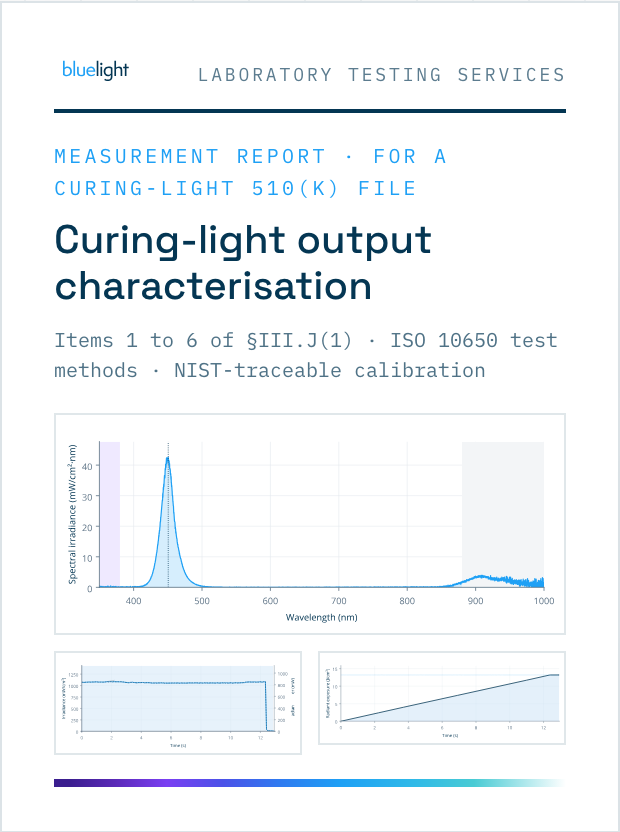
What you receive: the report, the protocol, the data, the calibration record, the plots.
The six measurements
 01Total radiant power through the exposure cycle
 02Maximum irradiance at the light‑guide tip
 03Spectral plot with the peak wavelength and any output below 380 nm
 04Radiant exposure for each curing mode
 05Irradiance attenuation from 0 to 10 mm
 06Beam profile of the tip, on our laboratory profiler
All six, one laboratory, one report.
We report measurements; we don't provide endorsements. That independence is what makes the data usable in a submission.
In FDA's words: Section III.J(1), quoted verbatimfda.gov/media/74206/download
“Total radiant power output (or radiant flux) (mW) throughout the total exposure cycle;”
“Maximum light intensity (or irradiance) (mW/cm2) measured at the distal end (tip) of the device light guide;”
“Total spectral irradiance (mW/cm2 • nm-1) plot at maximum irradiance output (mW/cm2) versus wavelength (nm) at the tip of the device light guide showing the peak wavelength (nm) and ultraviolet wavelengths (i.e., < 380 nm);”
“Radiant exposure (or optical radiation dose) output range (J/cm2) calculated by multiplying irradiance (mW/cm2) outputs of the various curing modes by recommended curing times (s);”
“Irradiance attenuation plot, which is the irradiance (mW/cm2) versus vertical distance (from 0 mm to 10 mm at 2 mm increments) from the device light guide tip; and”
“Thermal image or beam profiler of cross section of light guide tip at maximum radiant exitance showing relative 'hot' and 'cold' spots across lateral surface of the device light guide tip.”
FDA, Dental Curing Lights – Premarket Notification (510(k)) Submissions, September 2, 2026, §III.J(1).
How it works
The light, its curing modes, the items you need, your filing date.
Fixed scope and a fixed quote, agreed before any measurement is made.
Samples come to our laboratory in Halifax, Canada.
NIST‑traceable calibration · Supports ISO 10650:2026 test methods · 18 journal papers naming the MARC Light Collector · Since 2009
Questions
Frequently asked.
- Does the MARC-LC produce all six measurements FDA's guidance lists?
- Five. The beam profile is produced in our laboratory on a camera-based beam profiler, not on the MARC-LC. The other five are spectroradiometric measurements the MARC-LC makes.
- Is Bluelight's instrumentation traceable?
- Instrument calibration is NIST-traceable, and the MARC-LC supports ISO 10650:2026 test methods.
Tell us about your light.
Measurements for a curing-light 510(k) submission or modification. Tell us about the light and we come back with a written protocol and a fixed quote.