01
Independent measurement
Your lights and materials measured on the same MARC-grade platform that backs our research, under controlled and field-realistic conditions, with results you can cite.
Solutions / Manufacturers
Bluelight has measured curing performance in 62,000+ clinics across 75+ countries. Through the CheckMARC program, we bring that real-world data, plus clinician engagement and ISO 10650-2 lab research, into your R&D, validation, and customer-success work.
Why this is your problem too
Your composite is validated to a degree of conversion at a defined radiant exposure. In the operatory, the energy that actually reaches the restoration is governed by distance, angle, exposure time, tip condition, and a light whose output has quietly drifted. The result is routinely a fraction of the dose you specified.
A 2 mm tip offset can cost 30–40% of delivered energy; a small offset combined with a 15° tilt can halve it. Below roughly 70% conversion (the floor of a deep posterior box is where it happens), the restoration looks perfect and starts its countdown to recurrent decay, debonding, and post-op sensitivity. The patient blames the filling. The filling was your material.
We have 275,000+ light evaluations quantifying exactly how wide that field distribution is, and a platform built to close it.
How we work with manufacturers
Most engagements combine them: field data to find the problem, clinician programs to fix it, and lab research to prove the result.
Every CheckMARC and CheckUp test is a timestamped, geolocated measurement of a real curing light, its irradiance at the tip and at 6 mm, its full spectral curve, and its delivery over the cure, tagged to the exact make, model, mode, and tip, and to the materials that clinic actually stocks. No survey, no lab proxy. The conditions your material meets in the mouth.
A composite rated for 10 J/cm² fails when the operator delivers 6. We make that gap visible and fixable, at the chair with CheckMARC, at events and CE with the MARC Patient Simulator, and we measure the improvement. Clinician engagement that protects your material's reputation and generates data at the same time.
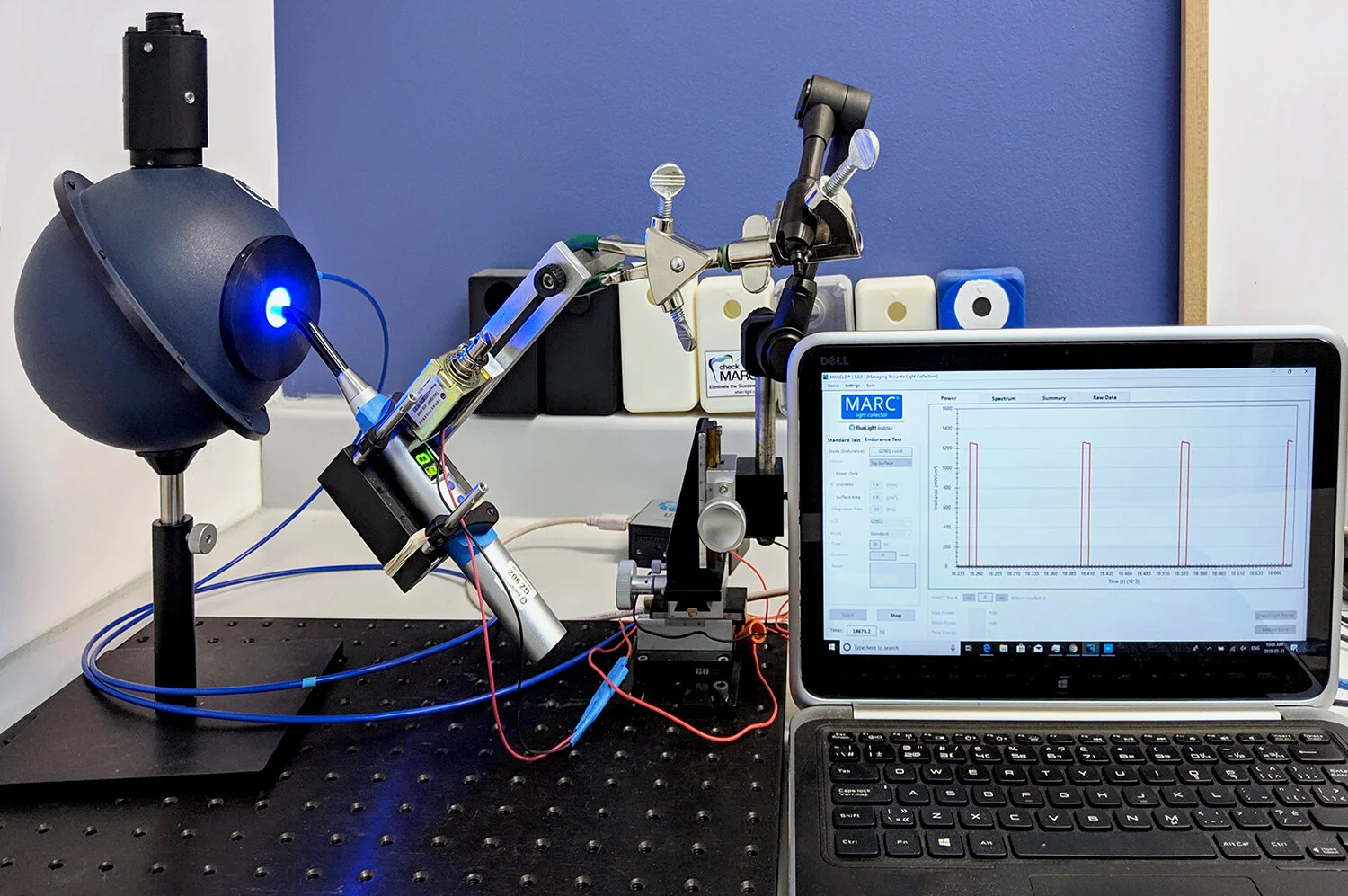
We conduct, and continue to conduct, light-curing research for partners around the world, on the MARC-LC laboratory reference: material characterization, light transmission, photoinitiator and wavelength matching, depth of cure, radiometer validation. NIST-traceable, ISO 10650-2, behind 200+ peer-reviewed publications. You bring the question; we design and run the study.
01 / The data
CheckMARC and CheckUp put a radiometer and a spectrometer in the operatory. Every test captures the irradiance a light delivers at the tip and again at 6 mm clinical depth, its full spectral curve, and how that output holds across the cure, tagged to the exact make, model, mode, and tip, and to the materials that clinic actually uses.
At scale, that becomes something no lab study can produce: the measured distribution of how your products perform in the field. How far real units drift from your stated output. How much irradiance collapses between the tip and 6 mm. How spectral output shifts as lights age. Which of your materials are being cured, by which lights, at what energy.
Independent field measurement already carries the argument: a 2021 study using the MARC reference found chairside radiometer error ranging from 7% to 535%, and a 2024 CheckMARC field study measured 1,067 lights across 544 offices. We scope custom analysis pipelines on this corpus, built to your product line.
02 / The clinicians
Your material's reputation is decided by people you never meet, in a step they were barely taught. Hand-counting "ten seconds" is wildly inconsistent, and operators cure the same tooth to very different doses. Engaging clinicians around correct curing is the highest-leverage thing a manufacturer can do to protect material performance in the field.
The MARC Patient Simulatormakes the gap undeniable. A clinician cures into a simulated mouth (anterior and posterior tooth positions, real spectrometer behind the sensor) and sees the energy they actually delivered in J/cm², ranked against the room. Blind-test mode masks the light's identity for unbiased comparisons; a variability readout flags when their hand drifted off target mid-cure. It is the booth that stops traffic at a congress and the instrument behind a CE session.
And it works: structured, feedback-based training has driven a 32% improvement in light delivery and cut pre-/post-training failure rates from roughly 37.5% to 2.5%. Every session is also a data-collection event (operator technique, by light, by material) that you own the insight from.
03 / The research
Bluelight has run light-curing research for partners around the world for two decades, and still does. On the MARC-LC laboratory reference (a NIST-traceable, integrating-sphere spectrometer, ISO 10650-2, resolved across 360–540 nm with the violet/blue split polywave lights demand), we characterize how a light and a material actually behave. More than 200 peer-reviewed publications have been built on the MARC platform, with researchers including Price, Shortall, Palin, and Hadis.
We run scoped studies on your bench or ours, and the output is an immutable, reproducible dataset in the formats your team works in, not a black box. Where it makes sense, we co-author.
These questions are not academic. A 2026 spectral study of eight multi-peak curing lights found their blue-to-violet output ranged from 3:1 to 30:1, and that violet light was attenuated ~98% through 4 mmof composite, so a "polywave" light may never activate a violet-dependent photoinitiator at the bottom of a bulk-fill increment. If your formulation relies on TPO or Ivocerin, that is a measurement question, not an assumption (Maucoski et al., 2026).
The CheckMARC program for manufacturers
CheckMARC already encodes, per material and shade, the irradiance band and energy your IFU demands, then tests whether real lights clear it. That same engine is how we structure a manufacturer engagement.
Your lights and materials measured on the same MARC-grade platform that backs our research, under controlled and field-realistic conditions, with results you can cite.
Aggregate, de-identified CheckMARC data from real clinics using your products: how far field units drift from your stated output, spectral output as lights age, and which materials are being cured at what energy.
We encode your material's required energy, irradiance band, and photoinitiator class, then test whether real-world lights actually clear it, at the tip and at 6 mm clinical depth.
CheckMARC turns a light's measured irradiance into the exact cure time your material needs in that operatory. Your material succeeds chairside because the protocol is matched to the light, not assumed.
CheckMARC is photoinitiator-aware: it distinguishes camphorquinone (blue, ~468 nm) from blue-violet systems, and references ISO 10650 for lights that emit outside the standard range. If your material depends on a specific wavelength, the program accounts for it.
Tell us a sentence about the product line and the question you're trying to answer: field performance, an IFU validation, a clinician program, or a study to publish. We'll scope the engagement around it.